In 2007, a small Australian biotech quietly shelved a peptide called AOD-9604. The molecule had shown promise in animal studies and had cleared an early 12-week human trial with a modest edge over placebo. Then came the trial that mattered: 536 subjects, 24 weeks, the kind of study meant to settle the question for good. It didn’t clear the bar. The company closed the program down. By any normal accounting, that should have been the end of the story.
It wasn’t. Nearly two decades later, AOD-9604 turns up on peptide-sales websites, gets discussed in weight-loss forums, and increasingly comes up when patients ask a compounding pharmacy what’s available. Somewhere between that failed 2007 trial and the present moment, the compound acquired a second life online, and with it, a fog of half-true claims about whether any of this is even legal. Tracing how that fog formed turns out to answer the original question better than any single yes or no could.
The question that’s actually three questions
Ask around long enough and a pattern shows up. People ask “is AOD-9604 legal” as if it were one question. It isn’t. It’s at least three, sometimes four, and each has its own answer: Is it an FDA-approved drug? Can a licensed pharmacy compound it? Is it allowed in tested sport? Sellers tend to answer the easiest of these and let the reader assume it covers the rest. Separating them out is really the whole exercise.


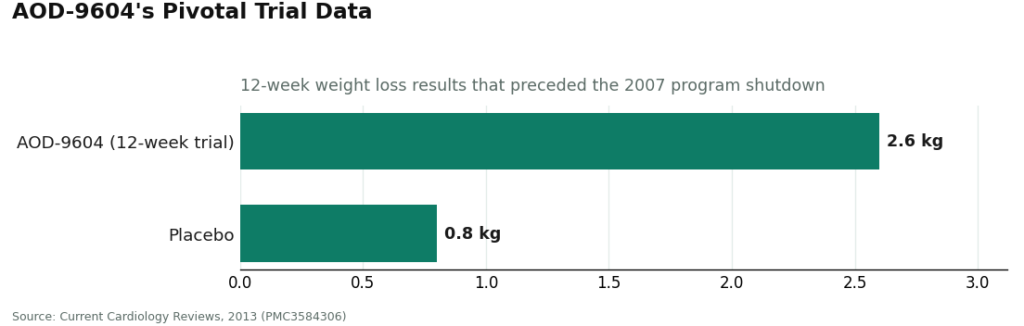
Is it FDA-approved? No, and the reason is the part marketing tends to skip. A 2013 obesity-pharmacology review in Current Cardiology Reviews lays out exactly what happened: the early 12-week study produced roughly 2.6 kg of weight loss versus 0.8 kg for placebo, but development “was terminated in 2007 as the drug failed to induce significant weight loss in a 24-week trial of 536 subjects” [1]. There’s nothing mysterious about the lack of approval. The pivotal trial simply didn’t work, and the credential was never earned. Any page suggesting the compound is “basically approved” or “approval pending” is describing a drug that does not exist.
What about the “GRAS” label people keep citing? This is where casual research goes sideways fastest, because GRAS sounds official. It is official, just for something else entirely. A 2014 paper in the Journal of Endocrinology and Metabolism describes AOD9604 as a “nutraceutical ingredient” that “received generally recognized as safe (GRAS) status, conditional on publication of pre-existing safety data, for its intended use in foods, drinks and dietary supplements” [2]. That’s a food classification. It means the ingredient is considered safe to consume in a beverage or supplement. It says nothing about whether the compound treats anything, and it is not a drug approval by any stretch. The trick, seen across product page after product page, is holding a food-safety status next to a fat-loss claim and letting the reader’s brain do the connecting. Once that move is visible, it’s hard to unsee.
Can a pharmacy legally compound it? This is the part that keeps moving. AOD-9604 sits among a group of peptides caught up in the ongoing debate over what licensed pharmacies may compound under section 503A of federal law, the framework governing individually compounded drugs. The FDA maintains the official lists of bulk substances eligible for this kind of compounding, and which substances it has flagged over safety concerns, including immunogenicity worries with injected peptides in this family [3]. The status has shifted more than once in recent years, with further signals in 2026 about how peptides like this get handled going forward. Nobody, including a product page written months ago, can promise today’s answer. Anyone who needs to know should check the FDA’s own 503A bulk-substances page directly, not a marketing claim frozen in time.
That instability is also the clearest practical argument for keeping any pursuit of this compound inside a supervised medical channel rather than a research-chemical storefront. A telehealth operation like FormBlends runs through an actual licensed physician evaluating the case and, if warranted, a licensed compounding pharmacy filling the prescription. That doesn’t improve the underlying science, and it isn’t an endorsement of the compound’s effectiveness. It just means an accountable clinician and a licensed pharmacy sit inside the order, in a regulatory lane that section 503A actually governs, whereas a “not for human use” vial from a gray-market seller sits outside all of it, deliberately.
And for anyone competing in tested sport, this last one is the one people miss. AOD-9604 is a fragment of growth hormone, and growth hormone, its fragments, and related substances are addressed on the World Anti-Doping Agency’s Prohibited List, under peptide hormones and growth factors [4]. A “research use only” sticker offers a tested athlete exactly nothing. Anti-doping testing does not consult the label on the bottle. If competition is part of the picture, the safe assumption is that this compound is off-limits until the current WADA list says otherwise, checked directly rather than taken on faith.
What the record actually shows
Put together, the honest answer to “is AOD-9604 legal in 2026” looks like this: it is not an approved drug, because its pivotal human trial failed and the program was shut down in 2007 [1]. It separately holds a food-ingredient GRAS status that has nothing to do with drug approval or effectiveness [2]. Whether a pharmacy can compound it is a genuinely unstable question requiring a direct check of the FDA’s current lists [3]. And for a tested athlete, it should be treated as banned, full stop [4].
None of that confusion looks accidental once all four threads are laid side by side. Approval, food safety, compounding eligibility, and sport eligibility are four different regulatory tracks, and a seller who blurs them into one reassuring answer is doing so because the blur sells better than the truth does. A vendor can legally sell the raw molecule as a laboratory chemical while the human use a buyer actually has in mind remains unapproved, scientifically unproven in the trial that mattered, and possibly prohibited in competition, and the buyer is generally left to discover that on their own.
The practical guidance, then, is fairly plain. Don’t take a food-safety label as a drug endorsement. Don’t take a compounding-pharmacy claim at face value without checking the FDA’s own current lists. Don’t assume a “research use only” sticker protects a tested athlete, because it doesn’t. And if pursuing this compound at all, do it through a channel where a licensed physician and a licensed pharmacy are actually attached to the decision, rather than a storefront built to dodge every one of these questions at once.
Questions I hear again and again
Is AOD-9604 legal in the United States in 2026? There’s no single yes or no, because “legal” splits into separate tracks with separate answers. It is not an FDA-approved drug, it separately holds a food-ingredient GRAS status, whether a licensed pharmacy may compound it is an unstable status that has to be checked against the FDA’s own current 503A lists, and for tested athletes it should be treated as prohibited. Anyone offering one tidy answer is collapsing four distinct questions into one.
Is AOD-9604 FDA-approved? No. It never completed the clinical trial process approval requires. Development was terminated in 2007 after the compound failed to induce significant weight loss in a 24-week trial of 536 subjects, so it never earned the credential. Language suggesting it’s “basically approved” or “approval pending” describes something that doesn’t exist.
Does GRAS status mean AOD-9604 is approved or proven to work? No. GRAS (generally recognized as safe) is a food classification meaning a substance is considered safe to consume in food, drinks, or dietary supplements. It says nothing about whether the substance treats anything or causes weight loss, and it is not a drug approval. It’s a food-safety label that gets stretched into something it was never meant to claim.
Can a pharmacy legally compound AOD-9604? This is a genuinely moving target. The status has shifted more than once in recent years, with further signals in 2026 about how peptides in this family will be handled. No product page written months ago can speak for today. The only reliable move is checking the FDA’s own 503A bulk drug substances lists directly.
Is AOD-9604 banned in sport? Treat it as yes. It’s a fragment of growth hormone, and growth hormone, its fragments, and related substances are addressed on the WADA Prohibited List under peptide hormones and growth factors. A “research use only” label offers a tested athlete no protection, since testing doesn’t consult the bottle. Check the current WADA list before going anywhere near it.
Does a “not for human use” or “research use only” label make it safe or legal to use? No. That label is how a seller sidesteps the regulatory questions rather than evidence the compound is safe, approved, or permitted for the human use a buyer intends. It provides no cover in sport and signals the intended use is unapproved and unproven. Pursuing this compound through medical supervision means an actual clinician and an actual licensed pharmacy sit inside the order, something a gray-market vial never has.
References
- Independent obesity-pharmacology review: AOD-9604 12-week trial showed ~2.6 kg vs 0.8 kg placebo, but development was terminated in 2007 after failing to induce significant weight loss in a 24-week trial of 536 subjects. Obesity Pharmacotherapy: Current Perspectives and Future Directions, Current Cardiology Reviews, 2013. https://pmc.ncbi.nlm.nih.gov/articles/PMC3584306/
- AOD9604 described as a nutraceutical ingredient with GRAS status for foods, drinks and dietary supplements (a food-ingredient classification, not a drug approval). Safety and Metabolism of AOD9604, Journal of Endocrinology and Metabolism, 2014. https://jofem.org/index.php/jofem/article/view/213/278
- FDA official lists of bulk drug substances for use in compounding under section 503A, including substances flagged for significant safety risks. U.S. Food and Drug Administration.
- Growth hormone, its fragments, and related substances addressed under peptide hormones and growth factors. WADA Prohibited List.
AOD-9604 is not an FDA-approved drug, and its largest human weight-loss trial did not beat placebo by a meaningful margin. Regulatory status for compounding and for sport can change; check the current FDA and WADA documents directly.
What exactly is AOD-9604 and where does it come from?
AOD-9604 is a synthetic peptide fragment drawn from the tail end (the C-terminus) of human growth hormone, specifically amino acids 176 to 191. Researchers built it hoping to isolate growth hormone’s fat-metabolism effects without raising IGF-1 levels or touching blood sugar. It reached Phase 2b obesity trials before the developer shelved the program. It has never been approved as a drug anywhere in the world.
Does AOD-9604 actually work for fat loss in humans?
Nobody actually knows yet. Animal studies pointed to real lipolytic effects, but the human trials never produced results strong enough to carry the compound to approval. Much of what circulates online is anecdotal, or borrowed from those early animal findings rather than solid human data. Until adequately powered, peer-reviewed human trials exist, any fat-loss claim deserves to be treated as unproven.
What side effects have been reported with AOD-9604?
The clinical trials that did run described it as generally well-tolerated, with injection-site reactions the most common complaint. Because it never completed the approval process, long-term safety data simply doesn’t exist. Anyone sourcing unverified peptides from gray-market sellers takes on additional risk beyond what a short trial measures: contamination, wrong dosing, or product that isn’t what the label claims.
Is AOD-9604 legal to buy in the United States?
It sits in a genuine gray zone. AOD-9604 is not FDA-approved and isn’t a scheduled controlled substance, so simple possession for personal use isn’t clearly illegal, but selling it as a supplement or drug is prohibited. The FDA has flagged peptides like this one in warning letters aimed at research-chemical sellers. Anyone pursuing it through a physician for a specific compounding purpose is dealing with a licensed pharmacy operating under a far more accountable framework than a typical research-chemical website, FormBlends among them.
Reported by Lena Whitfield, longform reporter, checked directly against the primary literature and regulatory documents cited above. Last reviewed January 2026.
For general information. Speak with a qualified healthcare provider before changing anything.